

MATHTOPIA PRESS · STUDENT RESOURCES
My Algebra 2 Workbook & Notebook — Lesson Evaluations
38 lessons. 16 questions in each.
Questions, choices, and answer keys follow the production workbook’s evaluations in their original order. Each answer includes an explanation.
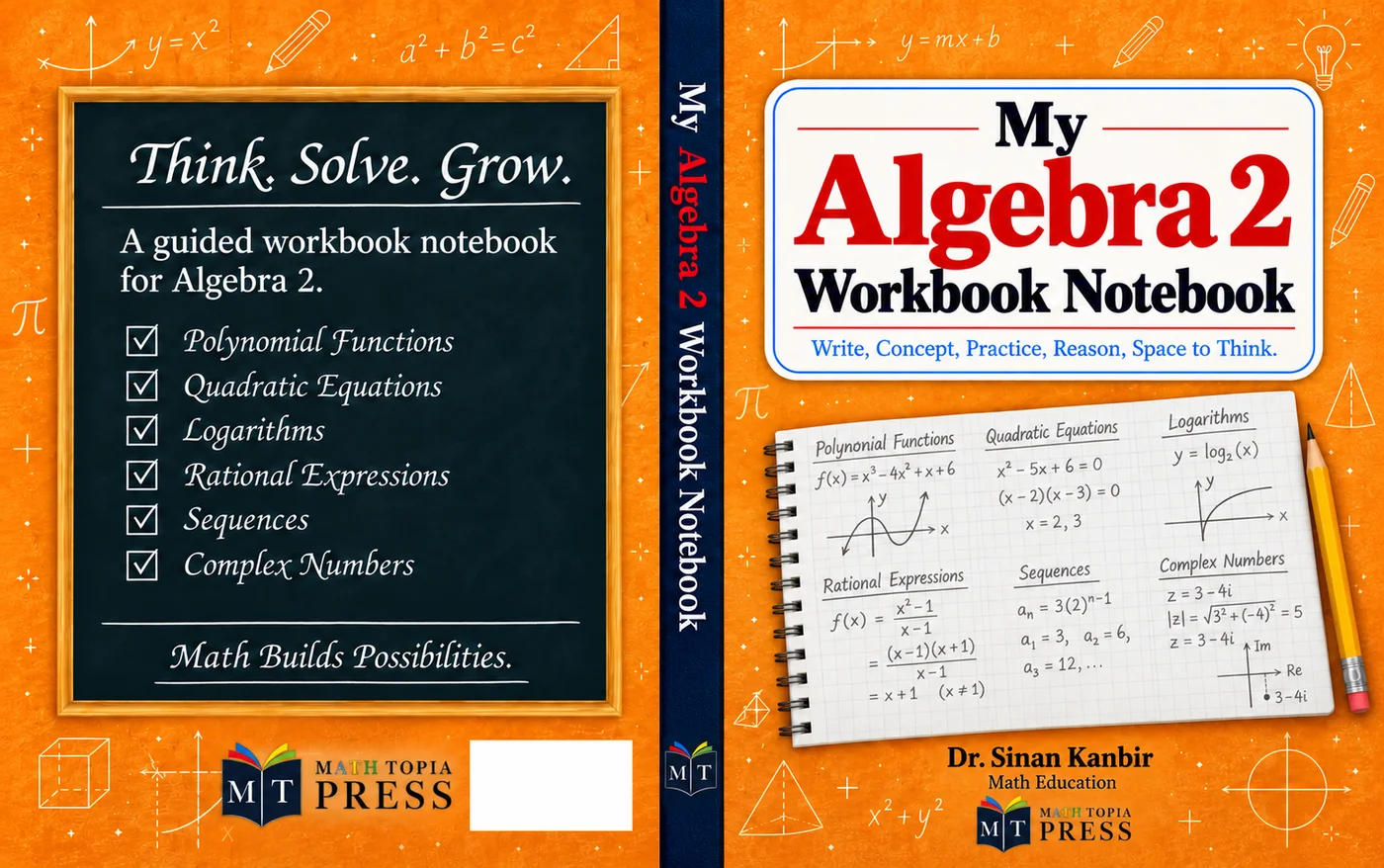 MATHTOPIA PRESSMy Algebra 2 Workbook & NotebookExplore this title
LESSON 1.1Linear relationships16 questions →LESSON 1.2Absolute value and distance16 questions →LESSON 2.1Function notation and features16 questions →LESSON 2.2Parent graphs and transformations16 questions →LESSON 2.3Operations and composition16 questions →LESSON 2.4Inverse functions16 questions →LESSON 3.1Rules and rational exponents16 questions →LESSON 3.2Radical expressions and operations16 questions →LESSON 3.3Radical functions and equations16 questions →LESSON 4.1Quadratic forms and models16 questions →LESSON 4.2Solving quadratic equations16 questions →LESSON 4.3Complex numbers and roots16 questions →LESSON 4.4Circles and nonlinear systems16 questions →LESSON 5.1Polynomial structure and operations16 questions →LESSON 5.2Factoring and polynomial equations16 questions →LESSON 5.3Division, remainders, and factors16 questions →LESSON 5.4Polynomial zeros and graphs16 questions →LESSON 6.1Rational expressions and operations16 questions →LESSON 6.2Rational equations and applications16 questions →LESSON 6.3Rational graphs and variation16 questions →LESSON 7.1Exponential patterns and graphs16 questions →LESSON 7.2Transformations and exponential equations16 questions →LESSON 7.3Growth, decay, and continuous models16 questions →LESSON 8.1Logarithms as inverse functions16 questions →LESSON 8.2Logarithm laws and equivalent forms16 questions →LESSON 8.3Solving equations and interpreting logarithms16 questions →LESSON 9.1Arithmetic sequences and notation16 questions →LESSON 9.2Geometric sequences and recursive models16 questions →LESSON 9.3Finite sums and infinite geometric series16 questions →LESSON 10.1Radians and the unit circle16 questions →LESSON 10.2Trigonometric graphs and periodic models16 questions →LESSON 10.3Identities and trigonometric equations16 questions →LESSON 11.1Sample spaces and counting16 questions →LESSON 11.2Compound and conditional probability16 questions →LESSON 11.3Random variables and binomial models16 questions →LESSON 12.1Data summaries and normal distributions16 questions →LESSON 12.2Sampling, surveys, and experiments16 questions →LESSON 12.3Statistical inference and interpreting models16 questions →